
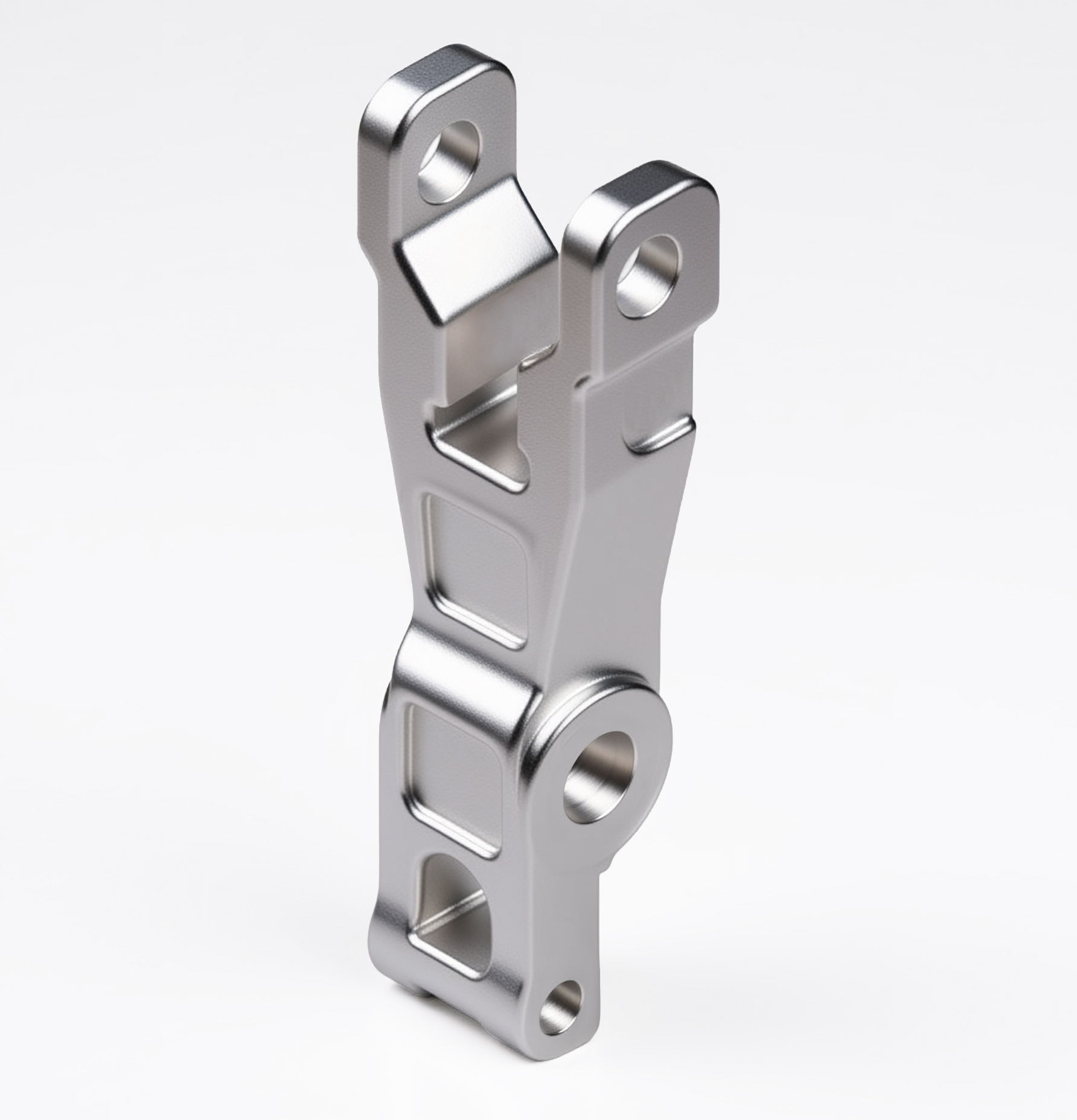
Industrial brake levers serve as critical mechanical linkage components, enabling force transmission and motion control functions. They are widely applied in the braking systems of mining machinery, marine cargo handling equipment, and port crane systems.
The machining challenge for industrial brake levers lies in their complex contours and precision multi-hole features. These components feature irregular three-dimensional geometries with multiple through-holes, requiring CNC milling centers with stable multi-axis machining capabilities to ensure positional accuracy and dimensional control for each hole location.
Manufacturing challenges also include stable machining of thin-walled structures. Lever components often incorporate lightweight designs, necessitating careful attention to workholding methods and cutting parameter control during milling operations to prevent deformation or chatter from compromising dimensional accuracy. Thread tapping operations also require equipment stability, particularly when working with aluminum alloy materials. Appropriate cutting speeds and coolant strategies are essential to ensure thread quality meets assembly requirements.
Heavy Machinery Equipment, Industrial Machinery Equipment
Active braking, armature brakes, band brakes, marine brakes, brake couplings, brake thrusters, caliper disc brakes, clutches and brakes, crane brakes, electric disc brakes, fail-safe brakes, hoisting brakes, hydraulic brakes, hydraulic caliper brakes, industrial brake calipers, industrial caliper brakes, industrial disc brakes, mechanical load brakes, overhead crane brakes, pneumatic brakes, rail brakes, railway brakes, safety brakes, shaft brakes, hydraulic brakes, wind turbine brakes, wind turbine brakes, wind generator brakes
View More...
View More...
View More...
Material Property Testing
Statistical Process Control
View More...
The selection of aluminum alloy reflects dual demands for lightweight construction and corrosion resistance in brake components. Compared to steel, aluminum alloy significantly reduces overall weight, offering distinct advantages for frequently actuated brake mechanisms while its excellent machinability enhances production efficiency. However, aluminum alloy's lower strength relative to steel necessitates structural optimization during the design phase to meet mechanical requirements, while imposing higher standards for dimensional accuracy control during subsequent machining operations.
WKPT possesses comprehensive aluminum component machining capabilities, providing integrated manufacturing solutions from CNC milling and drilling/tapping to liquid coating. Understanding the stringent quality requirements of brake system components, we accommodate customers' assembly tolerance specifications while ensuring consistent delivery and quality assurance. For projects involving complex contoured components or lightweight engineering solutions, we welcome the opportunity to discuss technical collaboration.